

Cognitive Assessment: KioCare vs standard screenings
Why Standard Dementia Screenings Miss High-Functioning Minds — and What KioCare Measures Instead
If you’ve ever walked out of a clinic with a “your score is normal” and still felt that something had changed, you’re not imagining things. For people who started with above-average cognitive ability, a normal screening result is one of the least informative sentences in medicine.
Here’s why — and what a more sensitive assessment actually looks like.
Why dementia screenings show normal results even after onset
The problem isn’t the test. It’s the ruler.
Screening tools like the MMSE and the MoCA were built to answer one question quickly: does this person show impairment right now? They’re short, inexpensive, and good at what they were designed for.
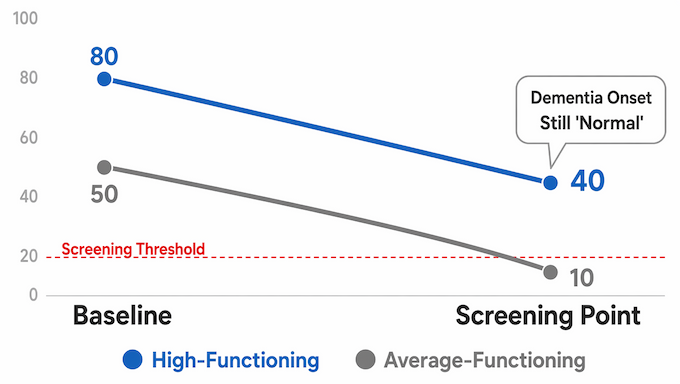
But “short” comes at a cost. Each cognitive domain is measured on a scale of just a handful of points. When a domain is scored out of 5 or 6, there is almost no room above the impairment line — a phenomenon known as the ceiling effect.
For someone whose baseline function was average, that’s fine: a real decline pushes them below the cutoff, the screening flags it, and a clinical pathway opens.
For someone whose baseline was high, the same absolute decline simply moves them from very high to high. They still land comfortably in the “normal” band. The change is real. The ruler just isn’t fine enough to show it.
That’s the gap. Two people can lose the same amount of function on the same timeline, and only one of them gets flagged.
The measurement gap, in numbers
The most direct way to see the difference is to compare how many points each assessment devotes to each cognitive domain. More points means more resolution — more room to detect a shift that hasn’t yet crossed into impairment.
| Cognitive domain | MMSE | MoCA | KioCare |
|---|---|---|---|
| Verbal memory (short & long-term) | 6 points | 5 points | 50 points |
| Auditory attention | 5 points | 6 points | 28 points |
| Frontal lobe & executive function | 10 points | 13 points | 154 points |
The contrast in executive function is the one worth pausing on. Frontal and executive abilities — planning, inhibition, mental flexibility, working memory manipulation — are typically among the earliest domains to shift, and they’re the ones high-functioning people are best at compensating for. A 10- or 13-point scale collapses all of that into a coarse pass/fail. A 154-point scale can show you where on the curve you actually sit, and whether that position is moving.
To be clear about what this table does and doesn’t mean: KioCare doesn’t replace the MMSE or MoCA, and a higher point total isn’t automatically better for every purpose. A two-minute bedside screen is exactly the right tool when you need a two-minute bedside screen. But if your goal is to notice a subtle change before it becomes impairment, resolution is the whole game.
Why a single score matters less than a trend
There’s a second limitation that has nothing to do with point totals: a screening gives you one number, one time.
Without a personal baseline, that number can only be compared against population norms — which is precisely the comparison that fails high-functioning people. Your “normal” and the population’s “normal” are not the same thing.
The more reliable comparison is you against yourself. A regular check-in builds a personal trend line, and a trend line answers the question a single score can’t: is this changing, and how fast? A stable high score and a quietly declining high score look identical on a one-time test. They look nothing alike on a chart.
Cognitive changes with and without treatment
Why timing is the whole point
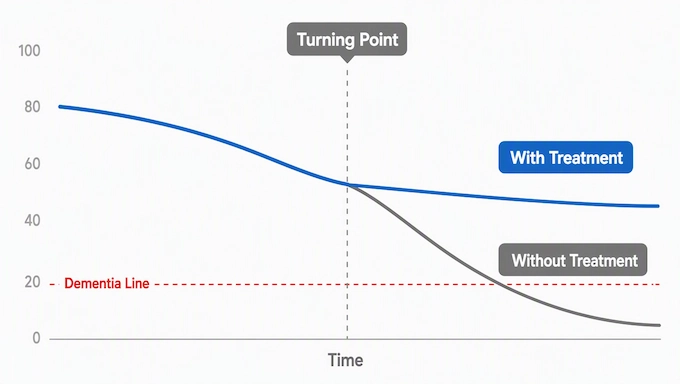
None of this would matter much if the window for action stayed open indefinitely. It doesn’t.
The current generation of early-stage treatments is indicated for early disease — the earlier the intervention, the more function there is left to protect. That makes the interval between “something has started changing” and “a screening finally flags it” the most consequential stretch of time in the entire process. For high-functioning people, that interval can run for years.
The goal isn’t to be alarmed. It’s to have information early enough that the choice of what to do with it is still yours.
What KioCare looks like in practice
KioCare is a phone-based cognitive assessment run by our expert team — no app to install, no waiting list, no clinic visit. We measure verbal memory, auditory attention, and frontal/executive function at clinical resolution, twice a year, and give you a professional report you can keep for your own records or share with your clinic.
Your baseline is yours. The point is to know what it is, and to notice when it moves.
KioCare is a wellness and healthcare management service designed for brain health tracking. It does not diagnose, treat, or cure any medical condition. Point values reflect the maximum scores available per domain in each assessment and are provided for comparison of measurement resolution only.